
Key Takeaways
- Effective blog growth strategies combine search-intent-driven content, deep topical authority, consistent publishing, proactive multi-channel distribution, and an owned email audience.
- Rather than chasing broad, highly competitive terms like "fitness tips" or "investing," focus on long-tail queries where user intent is explicit.
- Organize your articles using a hub-and-spoke (topic cluster) model.
- Building an owned distribution channel—specifically an active email list—is essential for insulating your blog against algorithm updates and search volatility.
- Quality and consistency matter far more than sheer volume.
Table of Contents
- 1. Why Do Most Blogs Fail to Gain Traffic?
- 2. How Can Search Intent and Content Depth Fuel Long-Term Blog Growth?
- 3. What Promotion and Collaboration Strategies Accelerate Blog Traffic?
- 4. How Do You Convert Readers into a Loyal Audience and Monetize?
- 5. Frequently Asked Questions About Growing a Blog
- 6. Conclusion
Effective blog growth strategies combine search-intent-driven content, deep topical authority, consistent publishing, proactive multi-channel distribution, and an owned email audience. In practice, that means targeting long-tail keywords with clear user intent, building comprehensive pillar-and-cluster content, repurposing posts across social and email, and converting readers into subscribers before monetizing through brand partnerships. Scaling a successful blog in 2026 requires understanding this compounding ecosystem rather than relying on guesswork.
Why Do Most Blogs Fail to Gain Traffic?
When we examine why so many creators struggle to scale, the root cause is rarely a lack of writing ability. In most cases, it comes down to flawed expectations, poor publishing rhythms, and the mistaken belief that good content will magically discover its own audience.
A recent industry study analyzed 50 SaaS-company blogs launched between January 2024 and June 2025. By December 2025, 31 of those 50 blogs had stopped publishing completely. Even more telling: the median number of posts published before abandonment was just nine.
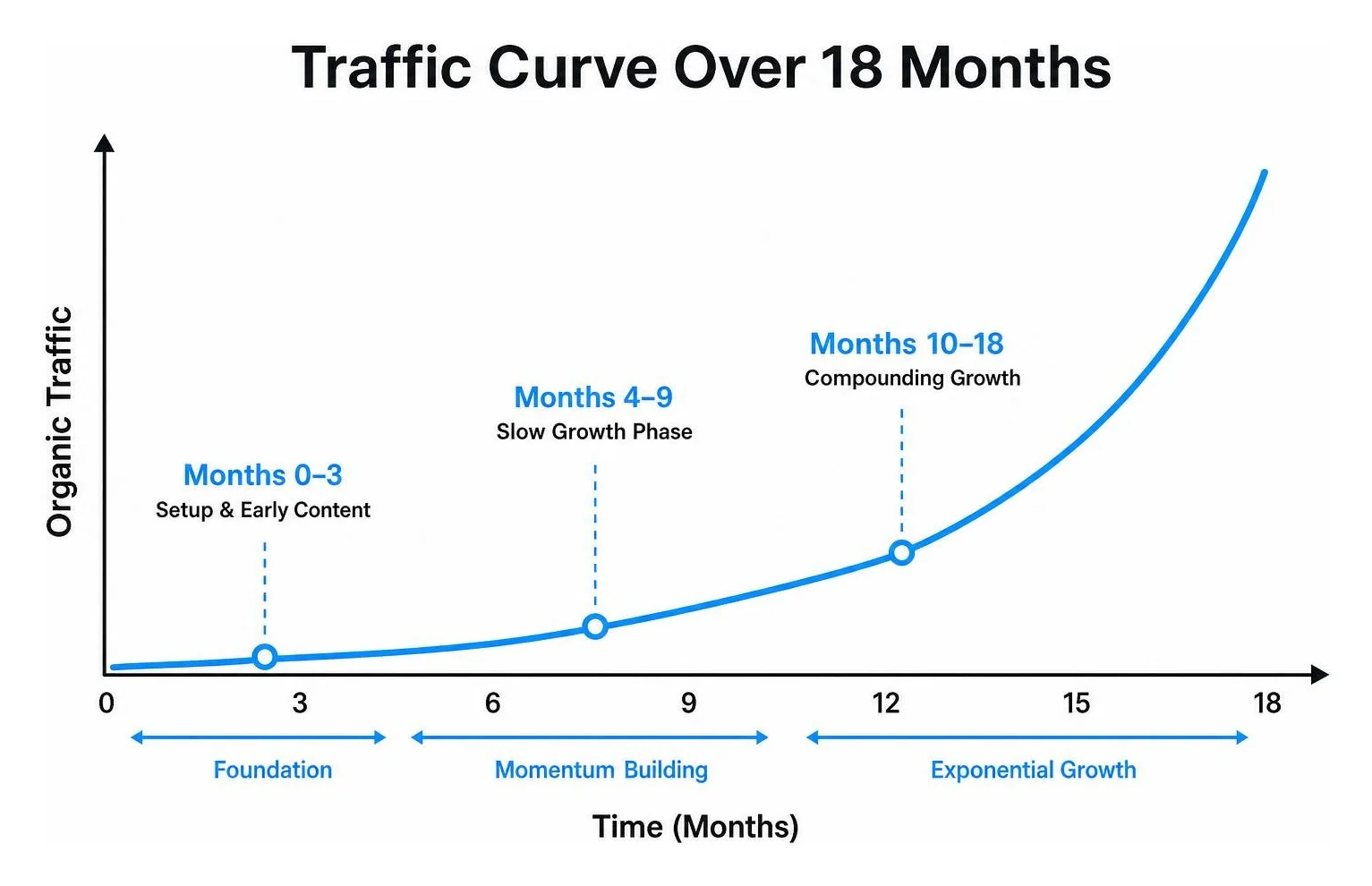
This happens because creators expect organic blog growth to follow a straight, linear path. In reality, growth is logarithmic:
- Months 1 to 6: You can expect roughly 5% of your blog's eventual lifetime traffic. Search engines are indexing your pages, establishing initial trust, and testing your content against existing authorities.
- Months 7 to 12: You begin to see compounding traction, generating around 15% of your traffic as your topical authority builds and primary rankings stabilize.
- Month 13 onward: This stage produces 80% of the organic traffic your blog will ever receive, provided you have maintained a steady publishing cadence.
When creators hit month four with little traffic to show for their effort, they assume their project has failed. They succumb to editorial drift—jumping between unrelated topics in search of a quick hit—or they fall into the trap of "publishing and praying," expecting Google to reward isolated articles without any proactive distribution. For actionable tactics on breaking out of this cycle, explore 40 Ways How to Grow a Blog Quickly in 2026.
Avoiding Premature Monetization and Low Quality
One of the quickest ways to stall early growth is monetizing before you have an established audience. Covering a new site in intrusive pop-ups and disruptive promotional clutter creates friction for the few visitors who do land on your pages. When early readers are greeted by slow loading speeds and aggressive interruptions, bounce rates surge and time-on-page drops—sending negative engagement signals to search engines.
Before attempting to generate revenue, focus on delivering deep, original insights that directly resolve your readers' problems. Take time to validate user demand before writing. If you want to understand how a structured foundation works from day one, reviewing How to Start a Business Blog in 2026 (9-Step Launch Plan) provides valuable clarity on sequencing your rollout.
Maintaining Consistency and Preventing Burnout
Another major failure point is the "burst publishing" trap. Writing five articles in a single week and then going dark for six weeks harms both search indexing and reader retention. Search algorithms reward fresh, steady signals of authority, while readers expect predictable publication schedules.
To build sustainable momentum, we recommend:
- Developing an editorial calendar 3 to 4 months in advance: Planning topics ahead gives you a safety buffer against unexpected schedule disruptions and allows search engines time to index seasonal content before peak interest hits.
- Batching operational workflows: Separate your tasks into dedicated time blocks. Brainstorm ideas on Monday, outline on Tuesday, draft on Wednesday, and edit alongside graphic creation on Thursday.
- Establishing positioning constraints: Ensure every single article aligns directly with your primary niche pillars so you avoid publishing off-topic filler.
How Can Search Intent and Content Depth Fuel Long-Term Blog Growth?
Organic search remains the single most reliable driver of compounding, long-term blog traffic. Industry research from Orbit Media Studios has shown that bloggers who routinely incorporate disciplined keyword research report far higher rates of success than those who write based on intuition alone.
Search engines have shifted dramatically. Algorithms prioritize comprehensive answers, direct experience, and topical authority over basic keyword repetition. Modern optimization requires understanding exact search intent and building structured, comprehensive resources that answer primary queries better than any competitor. When you build a solid foundation through an optimized SEO blog architecture, your organic traffic compounds month after month.
To see how high-impact content drives measurable results without massive teams, check out this breakdown of Scaling a Blog from 0 to 35k Visitors.
Finding Low-Competition, High-Intent Keywords
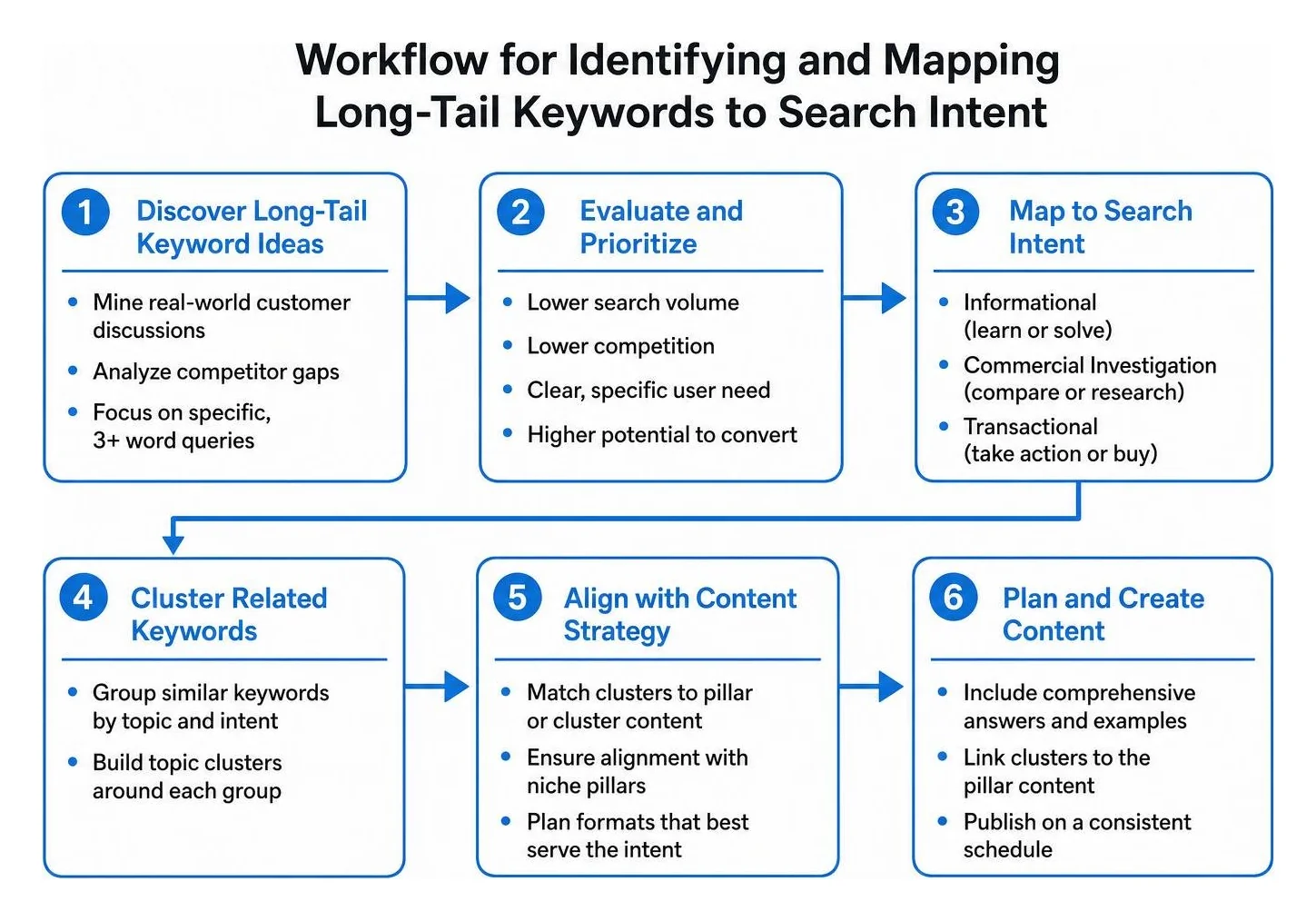
Rather than chasing broad, highly competitive terms like "fitness tips" or "investing," focus on long-tail queries where user intent is explicit. Long-tail keywords generally consist of three or more words, carry lower search volume, and convert at significantly higher rates because the searcher knows exactly what they need.
To uncover these opportunities:
- Mine real-world customer discussions: Browse niche subreddits, Quora questions, and community comment threads to see the exact phrasing people use when seeking solutions.
- Analyze competitor gaps: Study high-ranking competitor articles and identify subtopics, practical examples, or data points they failed to address.
- Map terms across the reader journey: Categorize your target keywords into informational ("how to clean a cast iron skillet"), commercial investigation ("best lightweight cast iron pans 2026"), and transactional intents ("buy vintage cast iron seasoning wax").
Crafting High-Impact Pillar and Evergreen Content
To dominate your niche, organize your articles using a hub-and-spoke (topic cluster) model. A central pillar post provides a thorough overview of a broad topic, while supporting cluster posts dive deep into specific subtopics, linking back to the main pillar.
When drafting these pieces, focus on creating high-value evergreen content that stays relevant for years rather than chasing temporary news cycles. Structure every guide with clean formatting:
- Descriptive subheadings (H2, H3): Help search engines and readers parse your core arguments quickly.
- Concise, direct answer blocks: Place direct summaries immediately under major questions to increase the likelihood of capturing rich snippets and AI citations.
- Strategic internal linking: Connect relevant guides to distribute page authority and keep visitors exploring your site longer.
What Promotion and Collaboration Strategies Accelerate Blog Traffic?
Publishing remarkable content is only half the battle. If you rely solely on search engines during your first six months, your growth will be slow. To bypass the early sandbox phase, establish a proactive multi-channel distribution workflow.
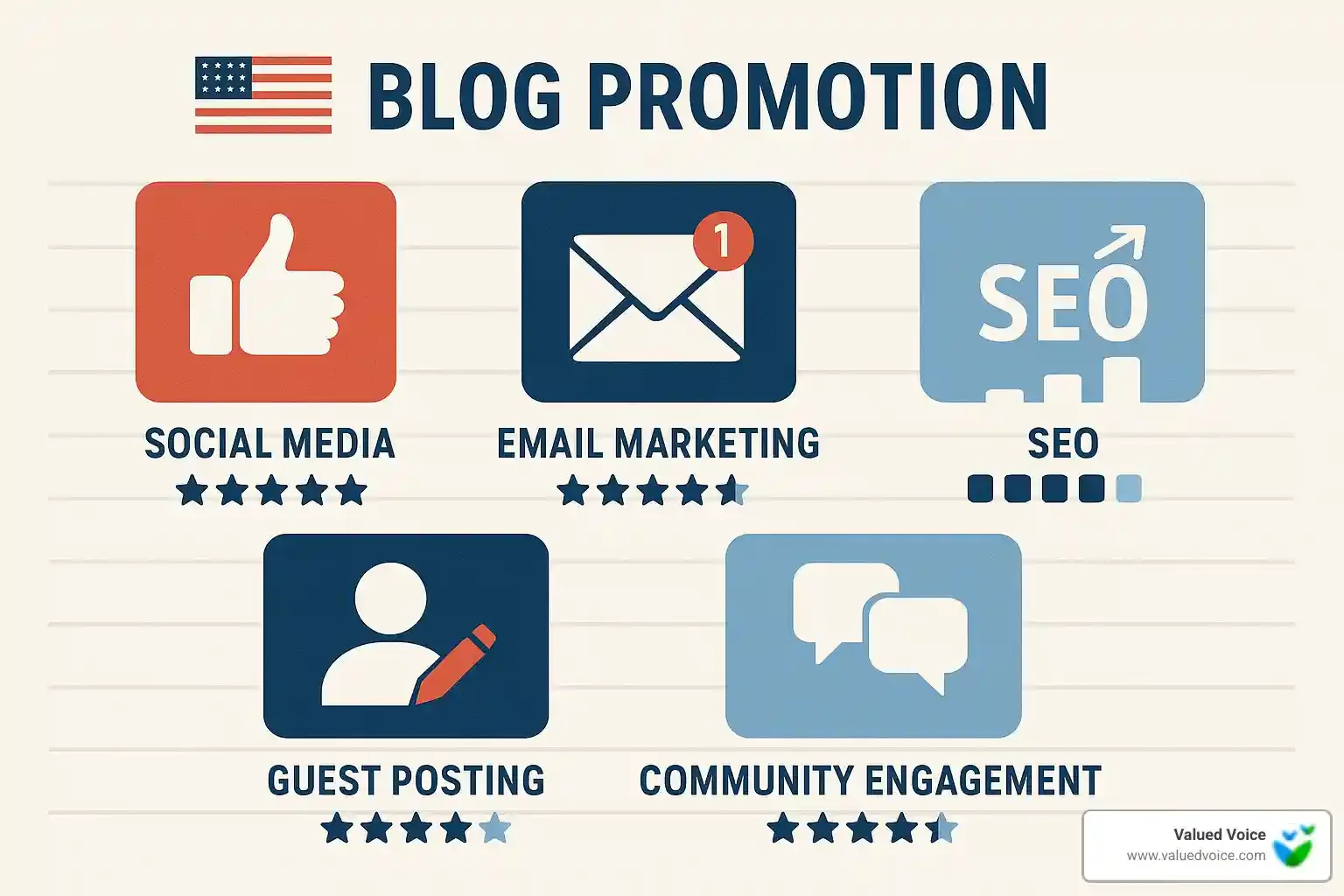
Instead of leaving an article to sit on your archive page, turn it into a distribution engine. Repurpose your core insights into digestible LinkedIn carousels, engaging social media threads, short-form video scripts, and newsletter segments. Organizing your campaigns with dedicated social media calendars ensures you maintain an active promotional presence without burning out.
You can also leverage user generated UGC to build authentic community proof and encourage social sharing across networks.
Leveraging Guest Posting and High-Authority Backlinks
Guest posting remains one of the fastest ways to borrow established audiences and earn authoritative backlinks. Rather than pitching generic ideas to hundreds of sites, target reputable publications within your specific vertical.
When executing a guest post outreach strategy:
- Evaluate audience engagement: Look for sites that demonstrate an active community, visible comments, and healthy social sharing.
- Pitch specific content gaps: Analyze the host's catalog to find topics they have overlooked. Frame your pitch around how your guide will solve a problem for their specific readers.
- Include contextual deep links: Ensure the host allows a contextual link back to a relevant, high-value guide on your own site—not just a generic homepage link.
- Follow editorial guidelines to the letter: Provide clean, fully formatted copy that requires minimal editing from their editorial staff.
For a broader breakdown of scaling content and digital authority across modern platforms, explore How to Start and Grow a Blog in 2026: The Complete Guide.
Utilizing Expert Roundups and Ego-Bait Content
Collaborative content offers a proven method for expanding your organic reach. As noted earlier, 63% of readers consider multi-author content more credible. You can capitalize on this through expert roundups and curated resource roundups (often called ego-bait content).
- Expert Roundups: Ask 10 to 20 industry practitioners a single, highly specific question (e.g., "What is your #1 tactic for lowering customer churn in 2026?"). Compile their answers into a comprehensive guide, then provide each contributor with pre-made snippets and graphics when the post goes live.
- Ego-Bait Lists: Curate authoritative lists featuring top practitioners, innovative tools, or standout industry case studies. Notify everyone mentioned with a quick, polite note. A substantial percentage will naturally share the recognition with their own followers.
Before reaching out for collaborations, warm up your relationships. Comment on their recent articles, share their work, and reply to their newsletters so your outreach comes from a familiar face rather than a cold pitch.
How Do You Convert Readers into a Loyal Audience and Monetize?
Traffic is meaningless if visitors land on your page once and never return. Building an owned distribution channel—specifically an active email list—is essential for insulating your blog against algorithm updates and search volatility.
Email subscribers represent your most dedicated advocates. They read new posts immediately, share content across their networks, and convert into paying customers at higher rates than cold organic visitors.
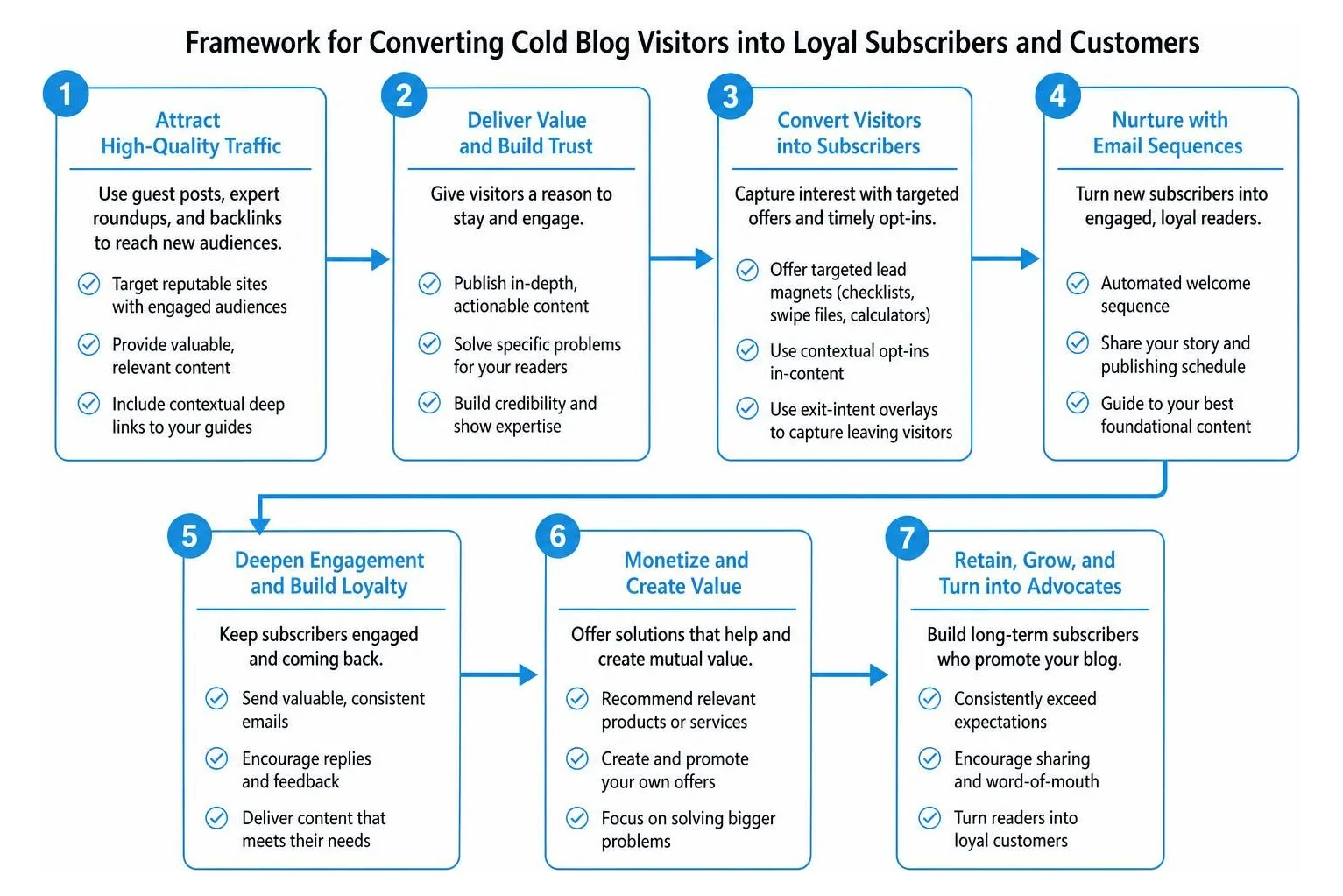
To build a high-converting reader acquisition system:
- Offer targeted lead magnets: Replace generic "join our newsletter" prompts with actionable, hyper-relevant downloads such as checklists, swipe files, or spreadsheet calculators.
- Set up automated welcome sequences: Introduce new subscribers to your brand story, outline your publishing schedule, and point them toward your most popular foundational content.
- Deploy contextual opt-ins: Place sign-up forms within the body of high-traffic articles and utilize clean exit-intent overlays to capture departing visitors.
Aligning Audience Demographics with Content
To maximize engagement, continuously analyze your analytics data to understand visitor behavior, bounce rates, and high-performing topics. When you take time to identify your niche target audience, you can tailor your messaging to their specific pain points and goals.
Engage directly with your audience by responding thoughtfully to every comment, sending occasional surveys to your email list, and incorporating reader questions into upcoming editorial themes.
Monetizing Sustainably Through Brand Partnerships
Once your blog generates consistent organic traffic and an engaged readership, you can introduce sustainable monetization models through direct brand partnerships. Sponsored content and influencer collaborations offer substantial revenue potential even for niche blogs with targeted audiences.
Understanding what makes a website attractive to advertisers—such as a clean design, verified domain authority, clear niche alignment, and an engaged audience—allows you to command premium rates.
At Valued Voice, we provide a streamlined creator platform that connects bloggers and digital creators directly with brands seeking sponsored articles and influencer collaborations. Creators maintain complete pricing control, keep full editorial freedom over what they publish, and benefit from fast, reliable payouts.
| Collaboration Format | Traffic Requirement | Revenue Control | Production Workflow | Ideal Best Practice |
|---|---|---|---|---|
| Sponsored Review Articles | Low to Moderate (Targeted Niche) | Full Control (Creator sets rates) | Fast turnaround, hands-on product analysis | Honest evaluation highlighting real user benefits |
| Dedicated Brand Features | Moderate | Full Control (Creator sets rates) | In-depth pillar guide spotlighting brand solutions | Seamless integration into existing niche topic clusters |
| Long-Term Brand Ambassadorship | Moderate to High | Full Control (Custom package pricing) | Multi-post series with ongoing social amplification | Consistent brand mentions across multiple publishing cycles |
| Co-Created Thought Leadership | Low to High | Full Control (Creator sets rates) | Collaborative expert interview or case study | Deep industry insights delivering mutual credibility |
Frequently Asked Questions About Growing a Blog
How long does it typically take to see significant traffic from a blog?
For most new blogs, generating meaningful organic search traffic takes between 6 and 12 months of consistent publishing. Search engines require time to discover new URLs, evaluate on-page relevance, and test how users interact with your content.
As highlighted by historical traffic curves, the first six months typically produce only about 5% of a blog's ultimate traffic potential. Once your site builds topical authority and earns backlinks, traffic compounds rapidly, with 80% of total lifetime views occurring after month 13.
What are the most important metrics to track for blog growth?
To measure the health and trajectory of your blog, monitor these core key performance indicators across Google Analytics 4 and Google Search Console:
- Organic Impressions and Click-Through Rate (CTR): Tracks your increasing visibility across search results pages before massive traffic arrives.
- Keyword Ranking Trajectory: Monitors whether your target long-tail terms are climbing toward page-one rankings.
- Average Engagement Time: Measures how thoroughly visitors read your articles, signaling content quality.
- Email Conversion Rate: The percentage of monthly unique visitors who join your email list.
- Returning Visitor Rate: Indicates how effectively your brand retains readers over time.
How often should a new blog publish content?
Quality and consistency matter far more than sheer volume. A single creator should aim for 1 in-depth, thoroughly researched post per week (4 articles per month). If you manage a team of contributors or freelance writers, a cadence of 2 to 4 articles per week can accelerate topical authority.
Never sacrifice research depth, readability, or optimization just to hit an arbitrary publishing quota. Publishing 30 high-impact, keyword-focused articles over six months will deliver better results than publishing 100 rushed, superficial posts. If you are refining your initial setup, reviewing How To Start A Blog: Complete Growth Guide and How to Start a Blog: The 7 Steps I'd Use Today provides helpful frameworks for managing production.
Conclusion
Scaling a blog is not an overnight endeavor, but it is one of the most reliable, compounding digital assets you can build. By aligning your content with search intent, creating comprehensive resources that solve reader problems, distributing your work through collaborations, and nurturing an email list, you establish a resilient platform that grows month after month.
Stay patient through the initial logarithmic curve. Treat content creation as an operational system: plan your topics in advance, maintain a steady publishing rhythm, and focus on delivering genuine value to your readers.
When your audience begins to grow and you are ready to turn your hard-earned traffic into a predictable income stream, join Valued Voice. Our platform makes it simple to partner with leading brands, set your own rates, and get paid for sponsored content while keeping full control over your blog's voice. Explore our platform pricing and start monetizing your content today.